

The Quiet Coup: DTCC and BitGo's Walled Garden for Tokenized America
CryptoVault
In the quiet spaces between market cycles, the most consequential moves often go unnoticed. This week, the Depository Trust & Clearing Corporation (DTCC) and BitGo announced a partnership to build digital asset infrastructure for tokenized U.S. Treasuries and equities. The crypto Twitter machine barely stirred. Yet for those of us who have spent years auditing the seams between traditional finance and blockchain, this announcement carries the weight of a tectonic shift—not because of what it builds, but because of what it reveals about the limits of our own decentralized dreams.
We often forget that DTCC is not merely a participant in American capital markets; it is the circulatory system. Every day, it clears and settles trillions of dollars in securities transactions, serving as the ultimate arbiter of trust for nearly every stock, bond, and ETF traded on U.S. exchanges. BitGo, meanwhile, has spent over a decade perfecting the art of institutional-grade digital asset custody, holding the private keys that guard billions in cryptocurrency. Together, they represent something the crypto industry has never truly faced: the establishment, not as an adversary, but as an architect.
The announcement itself was sparse on technical details—no mention of a specific blockchain, no timeline for launch, no clarity on whether this will touch a public network like Ethereum or remain sealed within a permissioned enclave. But the silence speaks volumes. Based on my experience auditing smart contracts during the 2017 ICO boom, I have learned that what is omitted from a press release often matters more than what is included. The absence of any reference to public blockchain infrastructure suggests a deliberate choice: this is not about bringing securities on-chain in the way we imagined. It is about grafting a digital asset shell onto the existing rails of Wall Street.
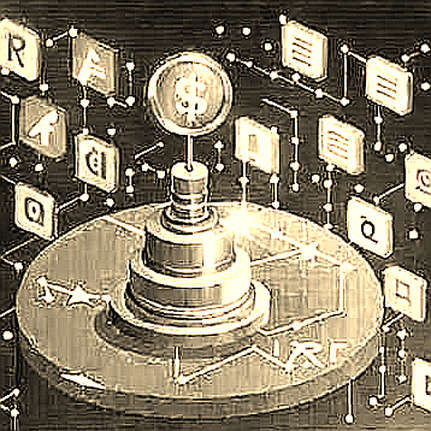
Let me be precise about what this means. The core architecture appears to be a parallel system, not a replacement. Traditional settlement will continue through DTCC's legacy infrastructure, while tokenized assets will flow through a new channel that combines BitGo's custody with DTCC's clearing capabilities. This is the institutional equivalent of building a high-speed rail line next to an existing highway—it does not eliminate the old road, but it offers a faster, more efficient route for those willing to pay the premium.
The trust model here is fundamentally different from anything in the crypto-native world. When Ondo Finance or BlackRock's BUIDL issues tokenized Treasuries on Ethereum, the trust anchor is a smart contract audited by third-party firms, with composability that allows DeFi protocols to integrate these assets into lending markets and yield strategies. The DTCC-BitGo model, by contrast, anchors trust in institutional identity. The network will almost certainly be permissioned, with KYC/AML requirements baked into the protocol layer. This is not a criticism—it is a recognition of reality. A regulated clearing agency cannot simply hand over its settlement responsibilities to a public blockchain without violating the very regulatory framework that gives it legitimacy.
But here is where my contrarian instincts begin to stir. The market is treating this as an unqualified victory for the RWA narrative, a signal that Wall Street has finally embraced blockchain. I see something more complex: a defensive maneuver disguised as innovation. DTCC has watched for years as platforms like Securitize and tZERO threatened to disintermediate the clearing and settlement process. By building its own digital asset infrastructure, DTCC is not embracing decentralization—it is ensuring its own survival. This is the institutional equivalent of a moat-digging exercise, designed to keep the castle walls high and the drawbridge firmly under its control.
The scalability challenges mentioned in the announcement are not incidental; they are central. Anyone who has worked with enterprise blockchain systems knows that permissioned networks face a different set of scaling constraints than public chains. The throughput may be higher, but the liquidity fragmentation is real. If tokenized Treasuries issued through this infrastructure cannot seamlessly interact with the broader DeFi ecosystem, they become a walled garden—beautiful, secure, but ultimately isolated from the very innovation that makes blockchain interesting.
I recall a conversation from 2020, during the early days of the Community DAO, when we debated whether institutional adoption would validate or co-opt the decentralized ethos. At the time, I argued that any bridge between traditional finance and crypto was inherently positive, that it would bring liquidity and legitimacy to our experiments. Three years later, after watching the FTX collapse and the subsequent regulatory crackdown, I am less certain. The DTCC-BitGo partnership is not a bridge; it is a border crossing with customs checkpoints, visa requirements, and a strict policy on who gets to enter.
This is not necessarily a bad thing. For pension funds and insurance companies, the ability to hold tokenized U.S. Treasuries with institutional-grade custody and settlement is a genuine improvement over the current system. The reduction in counterparty risk alone could justify the infrastructure costs. But we must be honest about what this means for the broader crypto ecosystem. If the most significant tokenized assets live on private networks controlled by traditional financial institutions, the composability that defines DeFi becomes irrelevant. The value accrues to DTCC and BitGo shareholders, not to token holders, because there is no token. This is a service business, not a protocol economy.
The regulatory implications are equally significant. DTCC operates under the watchful eye of the SEC, and any new product structure will require careful navigation of securities laws. Tokenized Treasuries are likely to face fewer hurdles, given their status as government securities. Tokenized equities, however, tread into murkier waters, potentially requiring the same registration and disclosure requirements as traditional stocks. The partnership may have already engaged in informal discussions with regulators—a common practice for systemically important institutions—but the public has no way of knowing. What we do know is that this infrastructure will be designed for qualified institutional investors, not retail participants. The era of open, permissionless access to tokenized securities remains a distant dream.
There is a deeper philosophical question here that we rarely confront. The blockchain community has long argued that decentralization is a technical property, not a political one. But the DTCC-BitGo partnership reveals the fallacy in that thinking. When the most powerful institutions in traditional finance adopt blockchain technology, they do so on their own terms, with their own governance structures, and their own definitions of trust. The technology is neutral; the application is not. We can celebrate the fact that DTCC is finally engaging with digital assets, or we can recognize that this engagement is fundamentally about control, not liberation.
During my months of solitude in the Victorian bushlands, after the FTX collapse, I wrote a private manifesto about the myopia of decentralization. I argued that our movement had become so focused on the technology of trust that we had forgotten the human dimensions of accountability. The DTCC-BitGo partnership is a reminder that institutions do not adopt blockchain because they believe in decentralization; they adopt it because it offers efficiency, transparency, and risk reduction within their existing frameworks. The question is whether we can find a middle ground—a space where institutional capital can flow into tokenized assets without sacrificing the openness that makes blockchain valuable.
I do not have a clear answer. But I know that the next two years will be decisive. If the DTCC-BitGo infrastructure succeeds, it will likely become the standard for institutional tokenization, setting the template for how other clearinghouses and custodians approach digital assets. If it fails, it will be because the walled garden proved too restrictive, too slow, or too expensive to attract the liquidity it needs. Either outcome will shape the RWA narrative for years to come.
In the meantime, I find myself returning to a question I have asked since my first audit in 2017: what is the purpose of this technology? If it is merely to make the existing financial system more efficient, then the DTCC-BitGo partnership is a triumph. If it is to create a new system that redistributes power and access, then this is a quiet coup—a reassertion of centralized control under the guise of innovation. The answer, I suspect, lies somewhere in between, in the messy, human space where ideals meet pragmatism. And that is where I intend to keep watching.
# Related

The 822x Meme Mirage: On-Chain Data Reveals a 1715x Discrepancy
CryptoFox
2026-08-17

Vitalik's Warning: The Unseen Gap Between AI Capability and Control
CryptoPrime
2026-07-21

The Ledger of Loyalty: Senegal's Coaching Coup and the Solvency of Fan Tokens
CryptoLeo
2026-07-15

Audit Complete: The 16% Phantom of the Oil Market – A Prediction Market Autopsy
CryptoCred
2026-07-24

The Data Alchemists: How Axis Robotics Is Forging the Fuel for Physical AI — and Why Crypto Should Care
0xKai
2026-09-05
The $300 Billion Whisper: Why Bond Markets Are the Crypto Trader's New Canary
CryptoEagle
2026-08-16

AWS Growth Under Pressure: A Chain-Level Reading of Cloud Dependency in Web3
CryptoNeo
2026-08-20